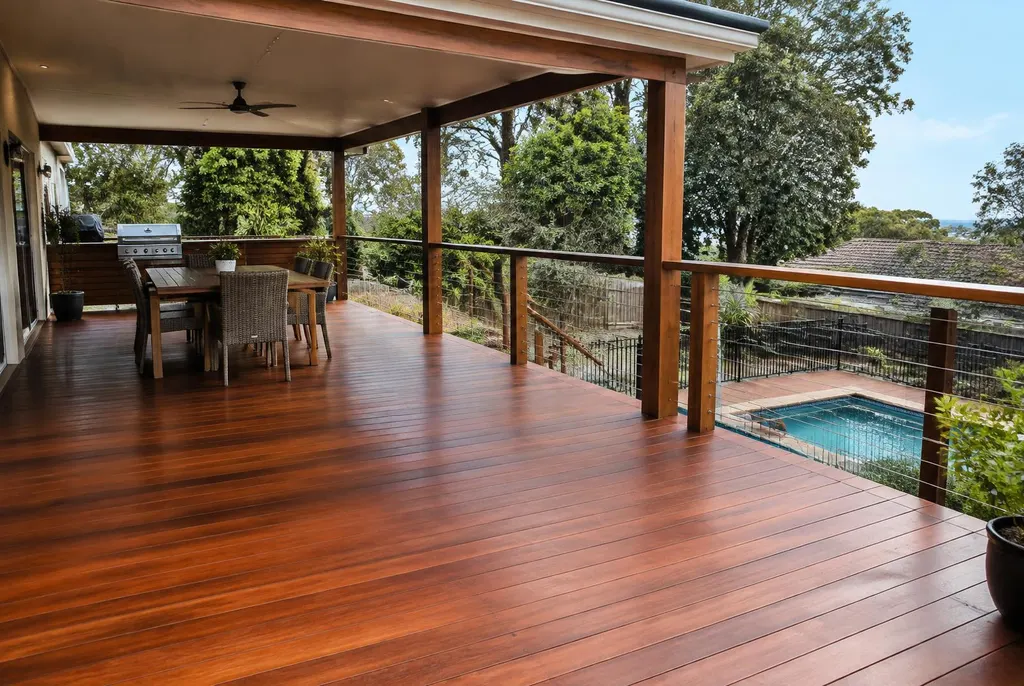
Composite decking in Newcastle: what the boards contain
Most conventional composite decking combines wood fibre with plastic and additives. The result is a manufactured board intended to reduce some of timber's maintenance demands. Recipes, profiles and surface treatments vary, so the word composite alone does not tell you enough about a product.
Capped boards have a protective outer layer designed to improve resistance to staining and weathering. Uncapped boards expose the underlying material and can behave differently when wet or dirty. Ask about the actual product rather than assuming every board shares the same surface, cleaning instructions or resistance to everyday spills.
What lower maintenance does, and does not, mean
Composite normally needs no oiling and avoids the timber splinters associated with weathered wooden boards. Its manufactured colour is consistent, and suitable products offer resistance to insect attack and rot. Those are practical benefits for busy households that want less coating work.
Lower maintenance does not mean leaving wet leaves, cooking grease or furniture marks indefinitely. Follow the cleaning instructions and use compatible products. Premium boards may come with long manufacturer warranties, but coverage depends on the specific product, installation and care requirements. Read those conditions before buying rather than treating a warranty as a promise about the entire structure.
Heat, scratches and other trade-offs
The upfront cost can be higher than a basic treated pine deck. Composite can also become hot in full sun, especially in darker colours. Take samples outside, consider the afternoon exposure and think about bare feet before choosing a charcoal board purely from an indoor display.
Unlike solid timber, a damaged composite surface generally cannot be sanded back to reveal a fresh face. Scratches, burns and deep marks may require board replacement. Quality varies widely between brands and product lines. Compare natural timber decking options if repairability, grain and the feel of real wood matter more than avoiding oiling.
Brands available in Australia
Brands available in Australia include Trex, ModWood, Millboard, NewTechWood, Eva-last, Ekodeck, TimberTech and Hardie Deck. This is a comparison starting point, not a claim of accreditation, endorsement or a supplier partnership. Availability and individual product specifications should be checked when the project is quoted.
These brands do not all use the same material technology. Some alternatives use mineral, resin or fibre-cement systems rather than a conventional wood-plastic blend. Compare the actual board's slip information, fire documentation where relevant, fixing method and care instructions. A familiar brand name is not enough to establish suitability for your particular site.
The subframe still does the hard work
Composite boards need support at the manufacturer's specified joist spacing. That spacing can change with board direction, stairs or the selected profile. Using an old timber deck frame without checking its layout and condition can create movement or sagging that new boards will not solve.
Ventilation and clearance beneath the deck remain important. Appropriate joist protection tape can help protect suitable framing details, while a properly designed steel subframe may be another option. Neither approach replaces good drainage. The frame, connections and board system need to work together rather than being selected as unrelated items.
Hidden fixings and movement allowances
Many composite systems use concealed clips for a cleaner surface. The clips are part of a specified installation method, not universal fittings that suit every board. Edge boards, breaker boards and steps may need different fixing details, and those decisions affect the finished appearance.
Manufactured boards expand and contract with temperature. End gaps, wall clearances and supported joins must follow the product instructions. Long runs need particular care so movement is accommodated neatly. Decide early whether you want picture framing, contrasting borders or straightforward board runs, because decorative details can increase framing work and material waste.
Composite around pools and coastal homes
Composite can be useful near pools because it avoids regular oiling beside the water. However, wet slip performance, heat and compatibility with pool chemicals still need checking. A textured surface should not be assumed safe simply because it looks grippy in a showroom.
Our pool decking design guide covers drainage, coping levels and barrier considerations. Coastal homes also need suitable corrosion-resistant hardware and sensible cleaning after salt exposure. Keep water moving away from the structure and leave access for inspection. The board may resist rot while an overlooked connection or poorly ventilated frame deteriorates underneath.
Composite pricing and a quote based on your site
Use the relevant indicative pricing rows below as a starting point, not a fixed offer. Board choice, hidden fixings, edge details, stairs, height and access all influence the supplied-and-installed scope. Removing an existing deck or upgrading its frame also changes the job.
See the composite decking cost guide and our deck construction questions before organising your measure. Bring sample colours and explain how much sun the area gets. Peter can discuss framing and layout alongside the board options, so the quote reflects the complete structure. For a free on-site measure and quote, Call Peter 02 4003 6068.
| Item | Indicative range |
|---|---|
| Composite deck | $300–$700 per m² |
| Balustrade (timber, wire, aluminium, glass) | $150–$700 per linear metre |
| Deck stairs | $170–$460 per step |
| Council approval (CDC or DA) if required | From $500 to $3,000+ |
Indicative 2026 Newcastle & Hunter ranges, supplied and installed, incl. GST. Your exact price is confirmed after a free on-site measure.